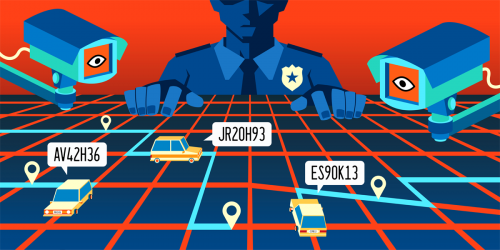


Throughout 2025, EFF conducted groundbreaking investigations into Flock Safety's automated license plate reader (ALPR) network, revealing a system designed to enable mass surveillance and susceptible to grave abuses. Our research sparked state and federal investigations, drove landmark litigation, and exposed dangerous expansion into always-listening voice detection technology. We documented how Flock's surveillance infrastructure allowed law enforcement to track protesters exercising their First Amendment rights, target Romani people with discriminatory searches, and surveil women seeking reproductive healthcare.
Flock Enables Surveillance of Protesters
When we obtained datasets representing more than 12 million searches logged by more than 3,900 agencies between December 2024 and October 2025, the patterns were unmistakable. Agencies logged hundreds of searches related to political demonstrations—the 50501 protests in February, Hands Off protests in April, and No Kings protests in June and October. Nineteen agencies conducted dozens of searches specifically tied to No Kings protests alone. Sometimes searches explicitly referenced protest activity; other times, agencies used vague terminology to obscure surveillance of constitutionally protected speech.
The surveillance extended beyond mass demonstrations. Three agencies used Flock's system to target activists from Direct Action Everywhere, an animal-rights organization using civil disobedience to expose factory farm conditions. Delaware State Police queried the Flock network nine times in March 2025 related to Direct Action Everywhere actions—showing how ALPR surveillance targets groups engaged in activism challenging powerful industries.
Biased Policing and Discriminatory Searches
Our November analysis revealed deeply troubling patterns: more than 80 law enforcement agencies used language perpetuating harmful stereotypes against Romani people when searching the nationwide Flock Safety ALPR network. Between June 2024 and October 2025, police performed hundreds of searches using terms such as "roma" and racial slurs—often without mentioning any suspected crime.
Audit logs revealed searches including "roma traveler," "possible g*psy," and "g*psy ruse." Grand Prairie Police Department in Texas searched for the slur six times while using Flock's "Convoy" feature, which identifies vehicles traveling together—essentially targeting an entire traveling community without specifying any crime. According to a 2020 Harvard University survey, four out of 10 Romani Americans reported being subjected to racial profiling by police. Flock's system makes such discrimination faster and easier to execute at scale.
Weaponizing Surveillance Against Reproductive Rights
In October, we obtained documents showing that Texas deputies queried Flock Safety's surveillance data in what police characterized as a missing person investigation, but was actually an abortion case. Deputies initiated a "death investigation" of a "non-viable fetus," logged evidence of a woman's self-managed abortion, and consulted prosecutors about possible charges.
A Johnson County official ran two searches with the note "had an abortion, search for female." The second search probed 6,809 networks, accessing 83,345 cameras across nearly the entire country. This case revealed Flock's fundamental danger: a single query accesses more than 83,000 cameras spanning almost the entire nation, with minimal oversight and maximum potential for abuse—particularly when weaponized against people seeking reproductive healthcare.
Feature Updates Miss the Point
In June, EFF explained why Flock Safety's announced feature updates cannot make ALPRs safe. The company promised privacy-enhancing features like geofencing and retention limits in response to public pressure. But these tweaks don't address the core problem: Flock's business model depends on building a nationwide, interconnected surveillance network that creates risks no software update can eliminate. Our 2025 investigations proved that abuses stem from the architecture itself, not just how individual agencies use the technology.
Accountability and Community Action
EFF's work sparked significant accountability measures. U.S. Rep. Raja Krishnamoorthi and Rep. Robert Garcia launched a formal investigation into Flock's role in "enabling invasive surveillance practices that threaten the privacy, safety, and civil liberties of women, immigrants, and other vulnerable Americans."
Illinois Secretary of State Alexi Giannoulias launched an audit after EFF research showed Flock allowed U.S. Customs and Border Protection to access Illinois data in violation of state privacy laws. In November, EFF partnered with the ACLU of Northern California to file a lawsuit against San Jose and its police department, challenging warrantless searches of millions of ALPR records. Between June 5, 2024 and June 17, 2025, SJPD and other California law enforcement agencies searched San Jose's database 3,965,519 times—a staggering figure illustrating the vast scope of warrantless surveillance enabled by Flock's infrastructure.
Our investigations also fueled municipal resistance to Flock Safety. Communities from Austin to Evanston to Eugene successfully canceled or refused to renew their Flock contracts after organizing campaigns centered on our research documenting discriminatory policing, immigration enforcement, threats to reproductive rights, and chilling effects on protest. These victories demonstrate that communities—armed with evidence of Flock's harms—can challenge and reject surveillance infrastructure that threatens civil liberties.
Dangerous New Capabilities: Always-Listening Microphones
In October 2025, Flock announced plans to expand its gunshot detection microphones to listen for "human distress" including screaming. This dangerous expansion transforms audio sensors into powerful surveillance tools monitoring human voices on city streets. High-powered microphones above densely populated areas raise serious questions about wiretapping laws, false alerts, and potential for dangerous police responses to non-emergencies. After EFF exposed this feature, Flock quietly amended its marketing materials to remove explicit references to "screaming"—replacing them with vaguer language about "distress" detection—while continuing to develop and deploy the technology.
Looking Forward
Flock Safety's surveillance infrastructure is not a neutral public safety tool. It's a system that enables and amplifies racist policing, threatens reproductive rights, and chills constitutionally protected speech. Our 2025 investigations proved it beyond doubt. As we head into 2026, EFF will continue exposing these abuses, supporting communities fighting back, and litigating for the constitutional protections that surveillance technology has stripped away.
This article is part of our Year in Review series. Read other articles about the fight for digital rights in 2025.