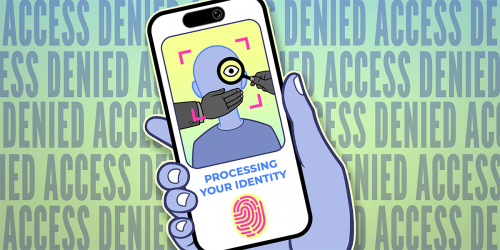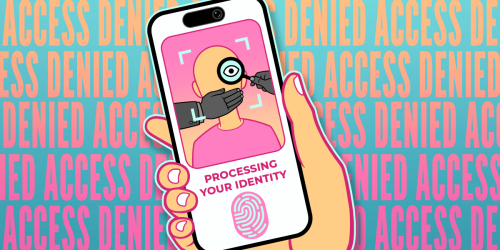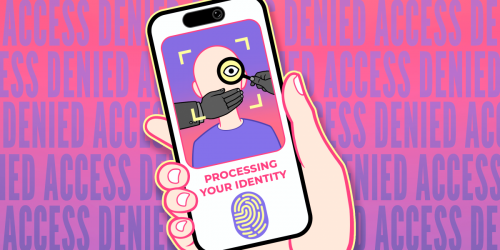

Here’s the kicker: the technology being used to implement these mandates isn’t even up for the task. Age estimation and ID verification tech is clunky at its best, and discriminatory at its worst. And every age-verification system is, at its core, a surveillance system.
While there are several different age-checking methods on the market, there is no technology available that is entirely privacy-protective, fully accurate, and that guarantees complete coverage of the population.
Facial-recognition systems are notoriously unreliable for marginalized communities, and commonly misjudge age based on skin tone, gender, and disability. And ID- or data-based systems exclude those who either don’t have ID or whose appearance doesn’t match their current documents.
The most common method of age verification—uploading a photo of your government ID along with a “live” selfie or video—is far more invasive than an in-person ID check.
Online, there’s no way for users to verify that their private information has been deleted, or to ensure that it won’t be copied, sold, or stolen. Companies that claim to delete personal data such as IDs—including age verification companies—have already experienced data breaches, and the more data a company collects, the more likely the chance of a data breach.
Alternative approaches, like facial age estimation or behavior tracking, aren’t safe either.
They rely on algorithms or AI systems with high error rates, particularly when it comes to estimating age across race and gender lines. Other schemes link users to financial databases or digital ID systems, worsening discrimination and excluding people in the process. Finally, as EFF has shown, even promising technologies like zero-knowledge proofs or VPNs can’t solve the underlying problem when the law itself is flawed.
These mandates create irresistible targets for hackers and governments alike, normalizing constant ID checks across the web and defying long-standing internet safety norms in the process.
No one should have to sacrifice their privacy or anonymity in order to exercise their free speech rights online.